
When did a bottle stop being a product and start functioning as a category?
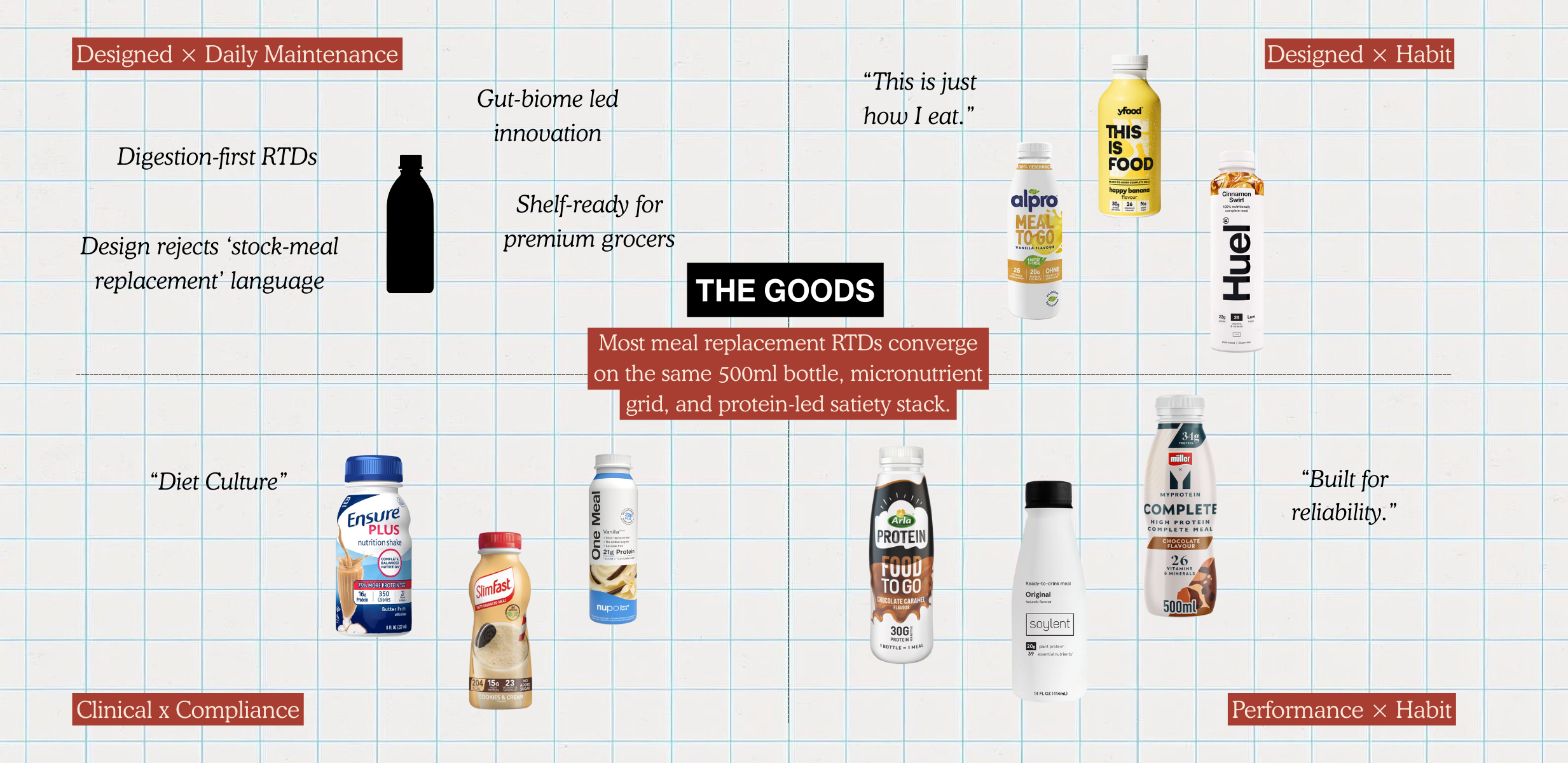
Meal replacement shakes emerged in the late 1950s and 60s from clinical nutrition. Brands like Ensure, introduced in the early 1970s, formalised the model: calorie-dense, micronutrient-complete, compliance-first. Through the 1980s and 90s, the category split in two, clinical nutrition (Ensure, Boost) and diet culture (SlimFast, Cambridge Diet).
Huel’s 2015 launch marked the category’s modern turn. Framed as “nutritionally complete food,” it recast meal replacement as functional design rather than dietary compromise. Distribution moved DTC. Messaging moved toward education. The use case shifted from weight loss to time scarcity and optimisation.
Today’s RTDs extend that logic. Taste has improved. Branding has softened. And by 2026, the frontier is fibre-maxxing, cleaner formulations, and products designed around specific moments rather than generic “meals.”
But as formulations converge on the same nutritional matrix, differentiation collapses toward branding, while unmet needs around appetite suppression, life stage, and long-term tolerance remain largely unaddressed.
Product design is narrowing, too. Most mainstream RTDs now converge on the same spec: the 500ml “meal bottle,” dense micronutrient grids (typically 20–26 vitamins and minerals), and a shared satiety stack built around added fibres like inulin, psyllium, or oat fibre.
Meal replacement is not just a shift in convenience food. It is becoming a proxy for how eating itself is reorganised when time, appetite, and attention are constrained.
As GLP-1 usage rises, eating patterns are changing in observable ways: smaller portions, fewer eating occasions, greater scrutiny around what earns its place in the day. In that context, products offering predictable satiety and nutrient density begin to function less like replacements and more as stabilisers, supporting digestion, energy, and consistency when intake is lower overall.
Fibre’s renewed prominence reflects a growing emphasis on digestion, tolerance, and maintenance, qualities that support long-term use rather than short bursts of optimisation.
The next phase of this category? Unlikely to be led by louder claims or more extreme formulations. It is more likely to fracture into products built for particular bodies, health goals, and constraints.




.png)