


In paid partnership with Tracksuit. Data provided by Tracksuit; editorial control by THE GOODS.
LONDON—I first noticed SURREAL, a UK challenger cereal brand built around high protein and low sugar, whilst scrolling LinkedIn. Their irreverent comms, consistently funny and, well, surreal, really stood out on a platform that is traditionally a dry place for brands to show up. They aren’t just using LinkedIn to post job ads or share stock social responsibility updates like a lot of legacy brands. It struck me that they use it to find their consumers who browse on IG in the evenings and on LinkedIn during the day and continue the antics.
Founded in 2021 by former Vita Coco executives Jac Chetland and Kit Gammell, son of Sir Bill Gammell, SURREAL trades direct-to-consumer while pushing decisively into supermarkets - the place where challenger brands find out, quickly, what the shelf will and won’t forgive.
In January 2024, SURREAL secured its first major UK listing with Sainsbury’s. The rollout was national across 461 stores. Three SKUs, Cocoa, Frosted and Cinnamon, priced at £4.95 for a 240-gram pack. At the time, Gammell framed the listing as a correction to a category long split between sugar and sacrifice. “Tasty cereals are full of sugar and healthy ones taste like cardboard,” he said. “We’ve taken the cereals we loved as kids and remade them to be healthy for grown-ups, without compromising on flavour.”
Cereal is undergoing quite the bifurcation. Legacy brands are reaching backward, reviving mascots and memory, while challenger CPG cereal brands position themselves for consumers who read the nutrition panel first.
John Gourville, Professor of Marketing at Harvard Business School, has repeatedly framed grocery choice this way: “Consumers don’t choose between products; they choose between keeping things the same and changing something.”
And now there’s a new accelerant. Weight-loss drugs. These people are eating less. Shopping more consciously. And asking harder questions about what’s worth eating at all. Nearly one in ten adults in Great Britain are already part of that shift, according to University College London. Which means cereal, like everything else, has to justify its place in the basket, and earn repeat purchase.
That’s the point at which SURREAL, the funny cereal brand, turns into a serious CPG business. Tracksuit’s brand mapping places SURREAL in an early but constructive position. Building awareness in a vast, mature category, paired with unusually high distinctiveness among those who do recognise it. For a young FMCG brand, growth from here continues to be about distribution, clarity, and disciplined repetition.

That seriousness shows up early in how the business was built. “We had two options,” Jac Chetland explains. “Buy a pre-made product from a manufacturer and get to market quickly, or build everything from the ground up. I was very much in the ‘let’s move fast’ camp, while Kit pushed hard for doing it properly from scratch.”
“Building it ourselves meant the product was designed entirely around customer preferences; taste first, nutrition second, no compromises,” says Chetland.
It’s a line that explains much of what followed, from manufacturing decisions to range discipline and well-chosen collabs. And why SURREAL’s shift from internet startup to supermarket fixture has happened faster than many perhaps expected.
Early brand tracking suggests it’s holding up. Data from Tracksuit shows that among consumers aware of SURREAL, associations cluster tightly around “low sugar,” “high protein,” and “modern”. These are signals that typically take years to establish in grocery.
Distribution has continued to widen. Sainsbury’s. Waitrose. Plus major online and convenience players.
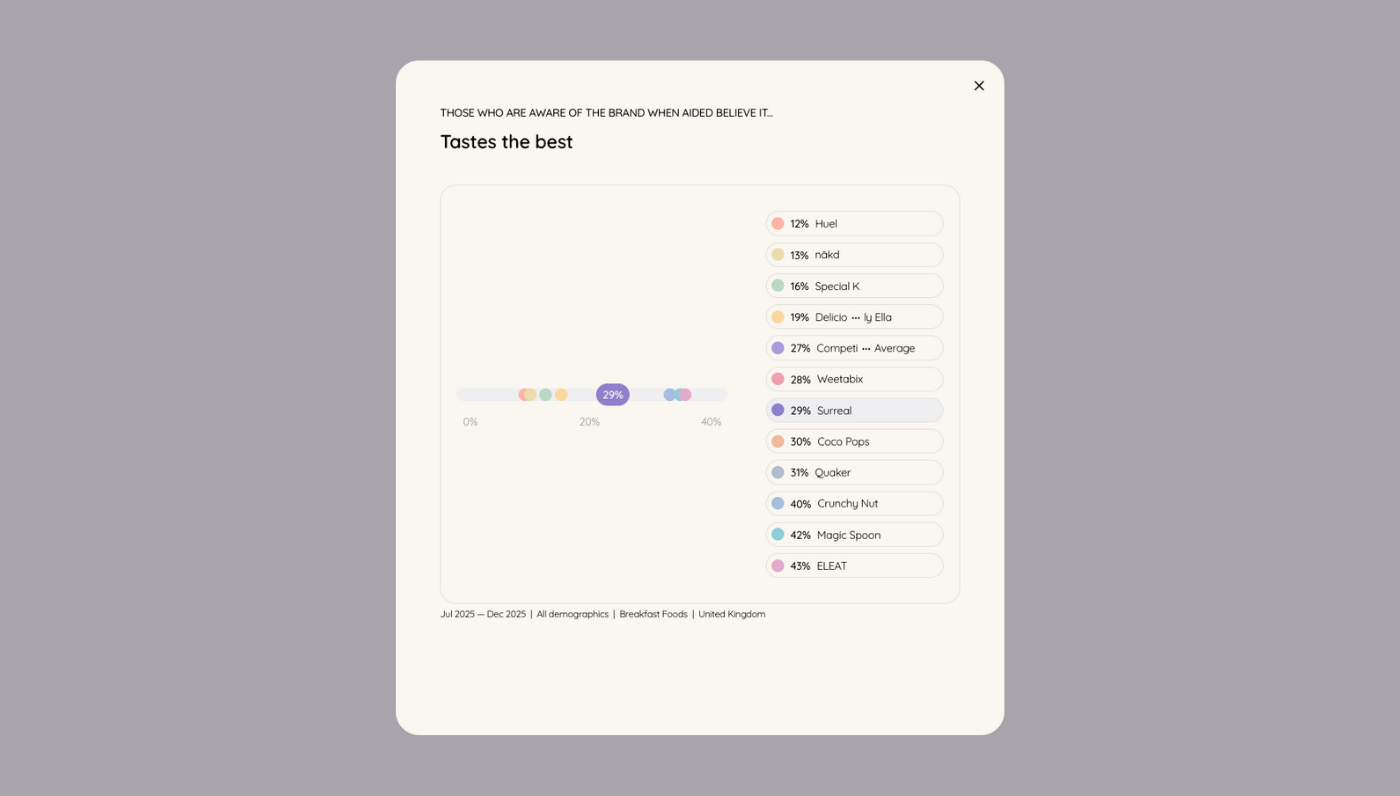
But shelf space isn’t the ultimate driver of long-term growth. Shoppers are. Among those who know the brand, 29 per cent say SURREAL “tastes the best”, outperforming the category average and edging ahead of several established names. That matters in a category where health cues have historically come at the expense of flavour. According to Tracksuit, taste is one of the most powerful drivers of cereal choice, carrying more than three times the relative importance of the average attribute.
When I speak to Chetland, he talks easily about humour, but more readily about systems and margins. And about the work of protecting the brand’s tone of voice as the business scales.
Tracing his ambition to become an entrepreneur in the first place, Chetland attributes his work ethic to his parents. “I grew up in Mallorca, my parents ran a restaurant,” he tells me. “Indian restaurant first, then an American diner, then a catering company. They liked to keep things interesting. They were constantly reinventing the business just to stay relevant, and work was never something they ‘went to’. It was part of who they were.”
He pauses. “I grew up assuming I’d do something similar one day. To build a business that felt bigger than a job, ideally in food and drink, serving real customers. I just didn’t expect it to be cereal.”
What he learned “the hard way,” he says, is that passion alone doesn’t carry you through it. “You need systems, resilience, and a thick skin. Loving what you do is amazing, but you also have to survive the tough days. For me, that means surrounding myself with people who can help get us through it.”
When Chetland and Gammell launched SURREAL, the ambition was to make “a cereal for adults” that could survive the UK’s tightening health environment and taste good.
Restrictions on the promotion and placement of foods high in fat, sugar and salt have already narrowed where many legacy cereals can appear in-store, while UK-wide limits on paid HFSS advertising came into force in January 2026. The result is a category where visibility is no longer evenly distributed. Products that fall outside HFSS, as SURREAL does by design, retain more flexibility across placement, POS and brand-led communication.
But to understand how SURREAL got here, it helps to go back to the beginning. What nearly stopped the business wasn’t anything internal, but external.
“Our original supply chain was never going to work,” Chetland says. “The product was made overseas, packed in the UK, and sold to UK customers. It got us to market, but in reality it was inefficient, terrible on cash flow, impossible to forecast, and completely unscalable.”
They were running out of money. “We needed to convince a manufacturer closer to home to take a big risk on us. Low volumes, lots of flavours, plenty of complexity. Not exactly an easy sell.” They pulled it off, “kept the lights on,” transitioned production and emerged with “a better product and a far more efficient setup. It was stressful, but it levelled us up fast.”
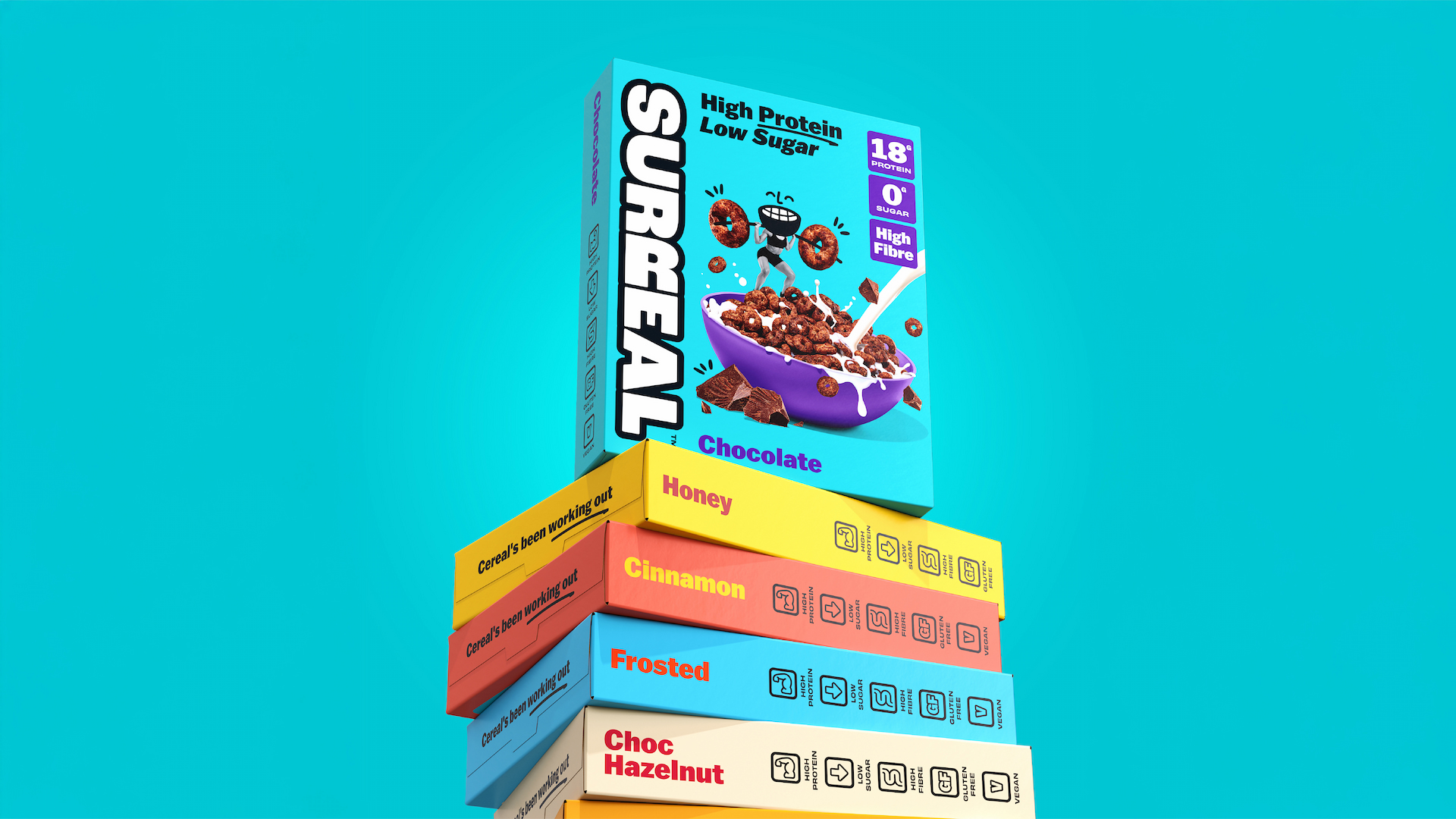
In November 2025, Earthling Studio debuted SURREAL’s redesign as the brand prepared to move further into mainstream supermarkets. Writing in Design Week, the studio described the brief as designing for “the very different battlefield of a grocery store,” without sacrificing the brand’s distinctive personality.
The changes were deliberately functional. Clearer messaging hierarchy, taste made explicit, nutritional benefits given immediate prominence. “The market wasn’t telling us there was a problem,” Gammell told Design Week, “but we had an inkling the pack could work harder. This was a chance to synthesise why SURREAL matters to customers into what is, ultimately, our most valuable billboard.”
Ultimately, the redesign builds a system that can stretch across formats and remove friction for shoppers encountering the brand for the first time — a system built for more markets further afield.
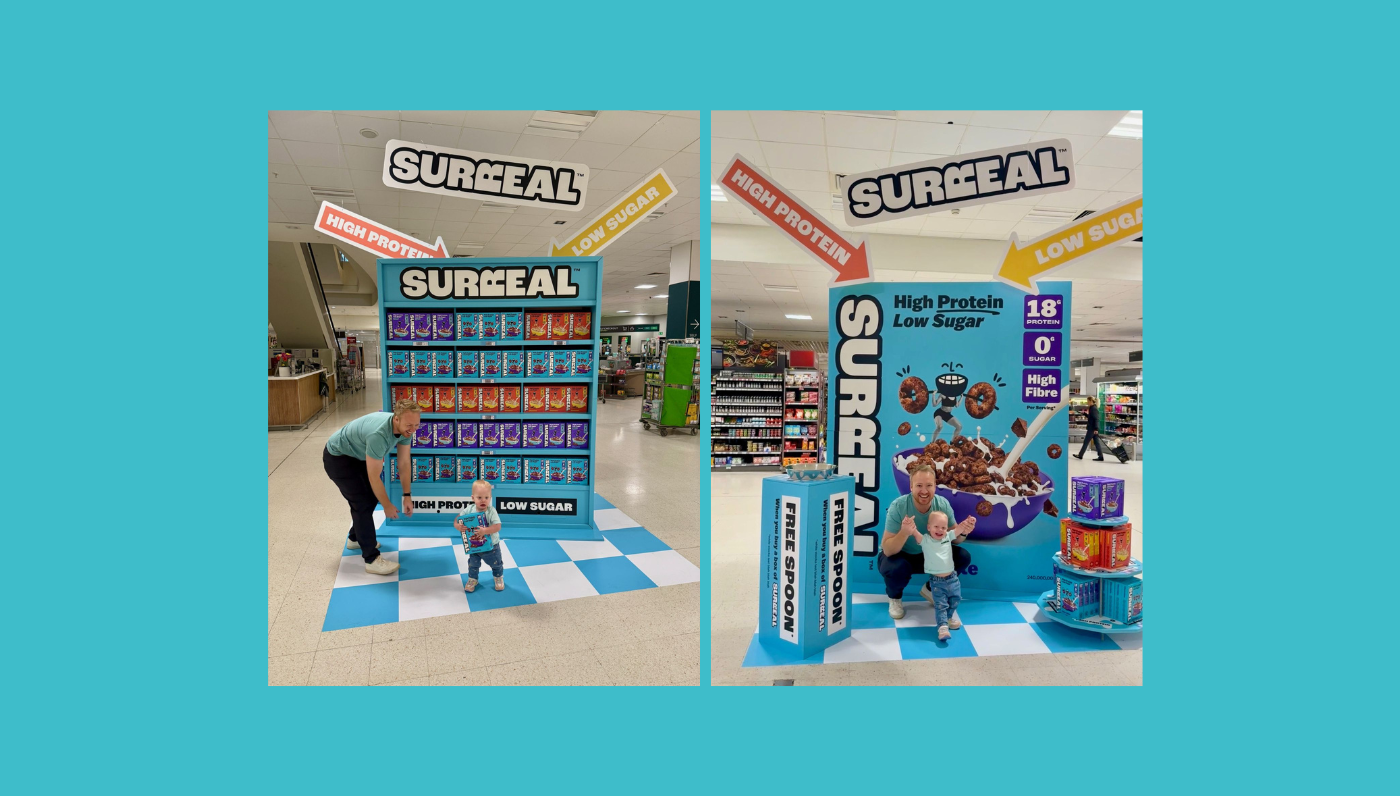
“I’m not going to pretend it wasn’t chaos,” Chetland says, laughing. “There was a lot of soul-searching, too much gut instinct at the start. Ultimately it came down to being really clear on the objective and making sure the work matched that.”
The outcome? “We’ve seen a huge jump in customer pick-up as a result of being clear on what we are. It sounds stupid in hindsight, but putting a bowl of cereal on the packaging seems to have helped customers.”
Online is a high-context environment, where brands can rely on in-jokes, memes and repeated exposure. Grocery retail is low-context by design. It penalises ambiguity in an already over-stimulated environment. On shelf, a product has seconds to answer three questions: what is it, why should I care, and will it taste good?
Online, SURREAL has built a following with a tone of voice coherent across channels, reaching more than 250,000 followers across Instagram and LinkedIn, and a willingness to make even the rebrand narrative part of the entertainment.
And SURREAL has supported its brand building with selective collaborations, including a limited-edition collaboration with Gymshark. The “Cardi-Os” launch targeted fitness consumers and was sold via SURREAL’s website and Gymshark retail, reinforcing the brand’s high-protein positioning rather than acting as a standalone stunt. Thus, a complementary brand fit as SURREAL continued to build awareness alongside its supermarket rollout.
Chetland explains: “We spend all our time thinking about how people will tell their friends about us. In an ideal world that means being ‘that high-protein, low-sugar cereal brand that’s funny’. When you boil it down, it’s about making someone aware of us and then helping them understand why we’d fit into their routine. It adapts based on the moment, channel and objective.”
As more people join SURREAL and the company grows, protecting the brand voice without freezing it in time becomes deliberate work. “We’re trying to build the future of cereal and that means constantly evolving is non-negotiable,” he says. “We’re clear on who we are and what we stand for, but bringing in more people lets us stretch within the creative framework we’ve set up.”
“The part of the brand we protect most fiercely is our tone of voice,” he adds. “We think great brands are like people. They learn, grow and evolve but the core personality is what makes them individual and special.”
And it’s worth remembering, this is still a brand in its infancy.
“The hardest part of building a playful brand when the stakes get serious,” Chetland says, “is keeping the humour when things genuinely go wrong. There are moments when the pressure is real and the consequences matter. A sense of humour doesn’t mean you’re not taking things seriously. It means you’re facing hard moments together.”
That’s why hiring becomes decisive. On what actually determines whether a challenger brand survives year two, beyond product and marketing, Chetland says, “Knowing when to hire, when not to hire, and who to hire. Hire too late and you’re in trouble. Hire the wrong fit and it’s worse. But when you get it right, it’s magic.”
He reflects on what experience has taught him. “I completely understand now why investors love backing second-time founders. The first time comes with mistakes and wasted time. But you can fail upwards. Things not working out doesn’t mean you’ve failed — sometimes it just unlocks a new direction.”
As this publishes, SURREAL is preparing to launch in the UK’s largest supermarket chain, Tesco. And in true SURREAL style, announcing the launch on LinkedIn, SURREAL wrote:
If the pattern in Tracksuit’s data holds as distribution widens, the next phase will be less about reinvention than repetition - earning trust at scale without dulling the edge that created it.
“Getting confirmation that we’re launching in Tesco has been huge,” Chetland says. “It’s one of those moments where you pause, take it in, and feel genuinely proud of how far the business and the team has come. That feeling’s going to be hard to top.”
Away from the business, both founders prioritise time with family. “Cleaning, feeding, napping, burping,” as he puts it. He’s about to travel to South Africa for his father’s 70th birthday. The last thing he bought for himself was a pair of binoculars, for that trip.
At the beginning, he reflects, “As a founder you live on an emotional rollercoaster. Paranoia, excitement, fear, optimism, sometimes all at once. The biggest fear early on was telling everyone we were doing this… and then actually having to do it. Once you say it out loud, there’s no hiding. Failing privately is one thing. Committing publicly forces you to follow through — and that’s terrifying, and exactly what pushes you forward.”





.png)